

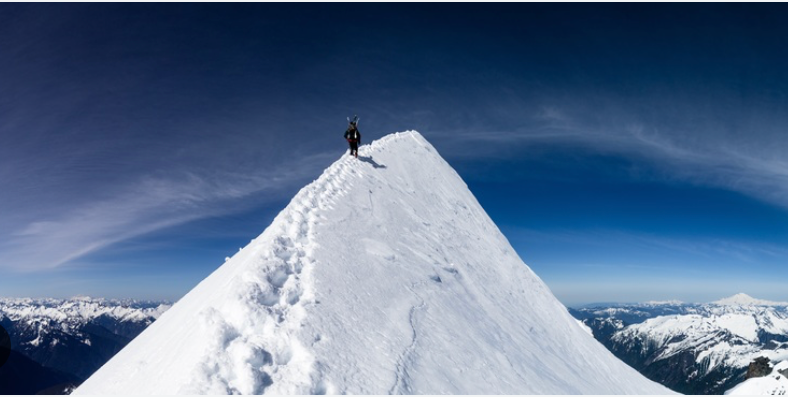
Soon after Anne and I arrived in Seattle, we became hooked on alpine climbing.
Three of our favorite climbs were:
The Inspiration Glacier Route on El Dorado
The Kautz Glacier Route on Mt. Rainier

and
The West Ridge of Mt. Stuart

It occured to me that alpine climbing was similar to surgery in many ways: it is rewarding, it is technical, and it turns out well most of the time.
Also, like climbers, surgeons often do not learn from past failures.
My friend, Colton Bramson, loaned me a book last night called Accidents in North American Climbing 2023. What stuck me as I paged through this book was that a substantial number of fatalities occurred during rappelling. For the non-climbers among you, rappelling is a standard method of descending from a climb in which the climber slides down a rope that is fixed to an anchor.

As can easily be seen there are many points of potential failure: anchor, carabiner, sling, harness, jumar and the rope (e.g. sliding off the end of the rope).
Causes of fatal rappel falls have been well documented:
2004 Devils Tower — Fatal rappel error – no knots at the end of the rope
2006: Sinks Canyon — Fatal fall while rappelling – no knots at the end of the rope
2016: Indian Creek — Uneven rope ends, no knots at the end of the rope
2017: Shelf Road — Fatal rappel error – improper set up of rappel system
2020: 6 rappel-anchor failures, 3 of them fatal
2022: Joshua Tree (broken sling) – fatality
Tahquitz (broken sling) – fatality
Mt. Evans (fell while pulling rope after rappel) – fatality
In spite of these examples of fatal errors from which climbers could learn, there were 8 known rappelling fatalities in 2023.
Accidents in North American Climbing sought to determine the cause of each failure, even when complete information was not available, and to suggest what could have been done to prevent the failure
45 yo female, Auburn Quarry-only one end of the rope passed through her belay device=>make sure both ends of the rappel rope are passed through the device
51 yo female, Joshua Tree-failure of old anchor and weathered sling=>avoid using anchor systems placed by prior climbers unless they are solid and in mint condition, take time to place new anchor system
22 yo female, Mt. Evans-fall while retrieving rappel rope=>make sure footing is secure and/or that the retrieving climber is anchored so that the act of rope retrieval does not cause a fall
58 yo female, El Dorado Canyon-one end of rope pulled through anchor=>tie knots in the end of each rope strand
two 67 yo males, Glacier National Park-hastily placed anchor pulled from rock=>take time to assure that anchor is solid and redundant
44 yo male, Leavenworth-poor anchor placement leading to anchor failure=>take time to assure that anchor is solid and redundant
33 yo female, Tahquitz Rock-failure of old anchor and weathered sling=>avoid using anchor systems placed by prior climbers unless they are solid and in mint condition, take time to place new anchor system

Surgery, like climbing, is usually wonderful,
but past failures contain lessons for preventing future failures

Mt. Rainier
August 2025

