

Stimulated by Herman et al 2026.[1]
cLBP – chronic low back pain
IF – impact factor
CEA – cost-effectiveness analysis
CUA – cost-utility analysis
EA – enhanced acupuncture (rather confusing I’m afraid)
SA – standard electroacupuncture
UMC – usual medical care
RMDQ – Roland-Morris Disability Questionnaire
MCID – minimal clinically important difference
EQ-5D-5L – health status questionnaire from EuroQoL
QALY – quality-adjusted life year
USD – US dollar
GBP – GB pound
CIs – confidence intervals
ICER – incremental cost-effectiveness ratio– key to acronyms
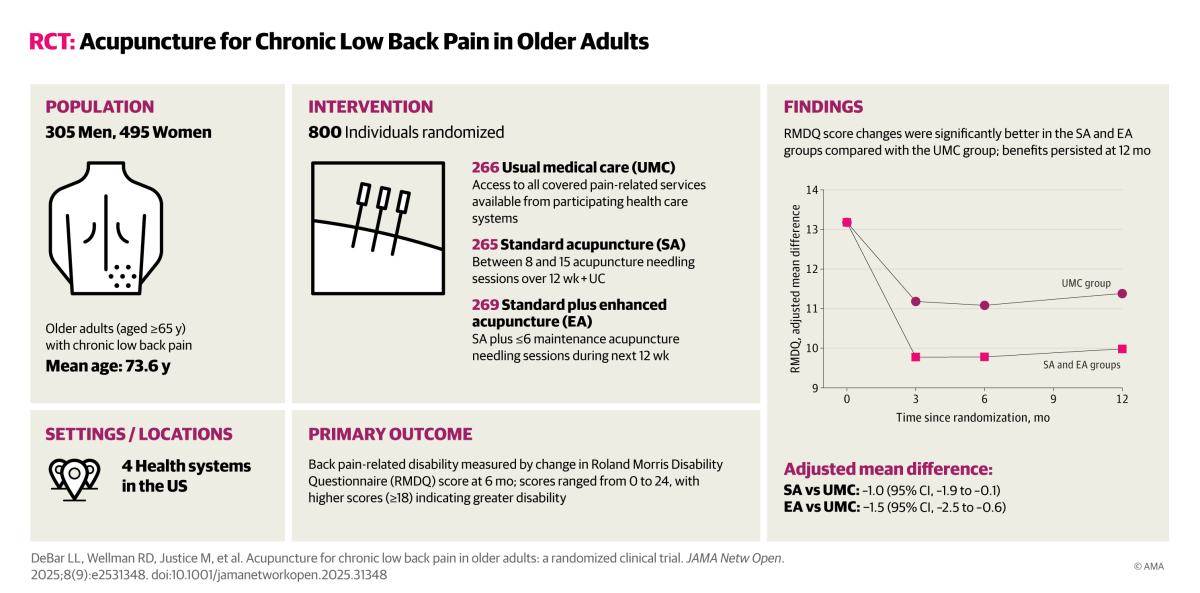
I seem to have pre-empted this paper in a previous blog on the original trial 4 months ago – see Acupuncture for cLBP 2025. The large pragmatic trial (n=800) by DeBar et al 2025,[2] was published in the journal JAMA Network Open (IF 9.7), whereas this pre-planned CEA and CUA is just out in the journal Spine (IF 3.5). Well, the paper itself leads with the statement that it was pre-planned, but I cannot find any mention of cost-effectiveness or cost-utility in either the main trial paper or the published protocol.[2,3]
As before, and rather confusingly, the acronym EA refers to enhanced acupuncture rather than the more familiar electroacupuncture. Enhanced refers to the addition of up to 6 top-up treatments following the main treatment course of 8 to 15 sessions over 12 weeks. The latter was referred to as SA or standard acupuncture. The third arm of the main trial was randomised to UMC and asked to avoid acupuncture.
Patients were 65 years or older and suffered with non-specific cLBP with or without radicular symptoms.
As I reported previously, the primary outcome in the main trial was the RMDQ, a 24-item measure of disabilities related to back pain. Higher numbers indicate greater disability and the MCID was taken to be a 30% reduction from baseline. In this economic analysis, the EQ-5D-5L was used to measure health status at baseline, 3, 6, and 12 months. This allowed for an estimate of change in QALYs over the period of the study.
The annual economic burden of cLBP in the US (where this research is based) is likely to be in excess of 100 billion USD. For comparison the UK figure is around 10 billion GBP. These estimates include direct healthcare costs as well as lost productivity.
In 2020, Medicare (in the US) began coverage of acupuncture for cLBP in older adults. It covers 12 acupuncture needling sessions over 3 months with an additional 8 sessions if the patient shows improvement, not to exceed a total of 20 sessions in a 12-month period. That sounds pretty good to me. So, Medicare covers the enhanced package from the original trial, although that could leave some patients with no more acupuncture sessions covered for the last 6 months of the year.
Acupuncture was paid at a rate of 90 USD per session, which was commensurate with the reimbursement level in most areas at the time of the trial, and patients had no copay requirement. Sensitivity analyses as part of the CUA allowed for both lower and higher costs (70.25 USD to 130.47 USD) per session. Sessions were reimbursed per 15 minutes, so this equated to 30 minute sessions and 60 minute sessions respectively.
I was surprised to see that enhanced acupuncture, which cost an additional ~1.5k USD, was associated with a reduction in total cLBP-related healthcare costs for the year. So, the enhanced acupuncture group cost 491 USD less per patient on average over the year. By contrast, the standard acupuncture group cost 759 USD more for the year compared with the UMC group. The acupuncture in this group cost just under 1k USD per patient, so there was a marginal saving in other healthcare costs compared with UMC, but not much.
The main saving in the enhanced acupuncture group was in terms of the cost of hospitalisations, which was down by an average of over 1k USD per patient. I cannot imagine that 1k USD will buy much inpatient care in a typical US hospital, so presumably this mean figure hides a smaller number of big spenders and a majority that stayed out of hospital with their cLBP.
As usual in CEA and CUA, the CIs are rather wide, leaving us with little absolute certainty over cost estimates. I was pleased to see one sensitivity analysis that excluded the outliers (2% at each end). This gave an ICER of just under 20k USD per additional QALY for enhanced acupuncture over UMC for cLBP. The equivalent figure for standard acupuncture came in at just under 40k USD. These numbers just span the threshold for buying healthcare interventions in the UK (20k to 30k GBP per additional QALY), with enhanced acupuncture (a course of treatment followed by top-ups) comfortably coming in below the threshold, and standard acupuncture (a one-off course of treatment over 3 months) looking as though it might be a touch too expensive for the UK.
References
1 Herman PM, Mann S, DeBar LL, et al. Cost-Effectiveness of Acupuncture Needling for Older Adults With Chronic Low Back Pain. Spine. 2026;51:E65–75. doi: 10.1097/BRS.0000000000005549
2 DeBar LL, Wellman RD, Justice M, et al. Acupuncture for Chronic Low Back Pain in Older Adults: A Randomized Clinical Trial. JAMA Netw Open. 2025;8:e2531348. doi: 10.1001/jamanetworkopen.2025.31348
3 DeBar LL, Justice M, Avins AL, et al. Acupuncture for chronic low back pain in older adults: Design and protocol for the BackInAction pragmatic clinical trial. Contemp Clin Trials. 2023;128:107166. doi: 10.1016/j.cct.2023.107166
Declaration of interests MC

Published by
Published

