

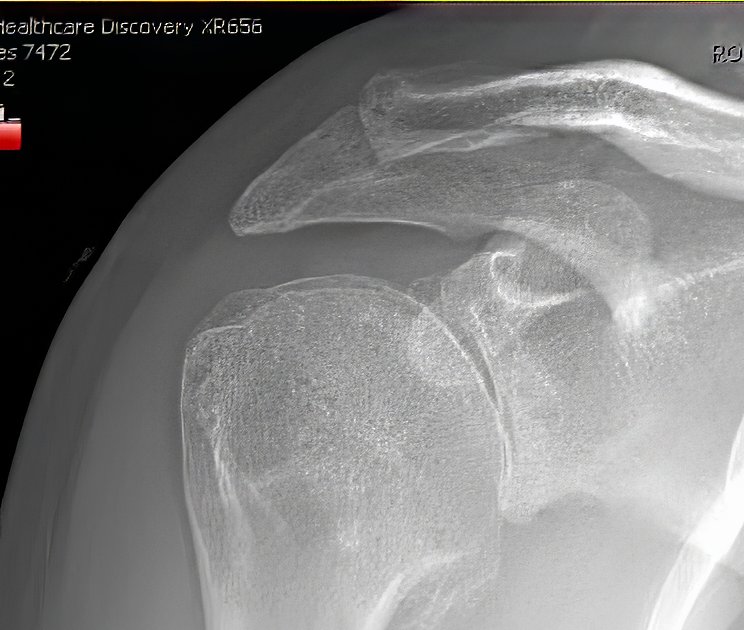
Here’s a case from last week: 40 year old very active man with these x-rays

From the white board in the OR, ROM under general anesthesia

Thus we have the familiar B2 paradox: a posteriorly decentered, unstable shoulder that is also stiff (FE -forward elevagion; ER – external rotation at the side; ERA – external rotation in abduction; IRA – internal rotation in abduction; CBA – cross body adduction (distance from antecubital fossa of surgical arm to contralateral acromion in cm)).
Our preop preview suggested a 50 20 humeral head. A preoperative CT was not obtained.

As usual the procedure was performed under a general anesthesia without nerve block. The shoulder was approached through a subscapularis peel, preserving the long head tendon of the biceps.
At surgery, the glenoid was biconcave in the posterior inferior direction (ellipse) rather than directly posterior with respect to superior / inferior axis (yellow line). This pathoanatomy would have been difficult to fit using an augmented glenoid component without excessive bone removal.

The glenoid was conservatively reamed to a monoconcavity without attempting to change glenoid version.

A short humeral stem was inserted.
As pointed out in prior posts, the key is not a preoperative plan or attempting to match a preoperative plan with expensive technology (e.g. robotics, patient specific instruments, virtual reality, or augmented reality). These approaches do not recognize the importance of soft tissue balancing.
Instead, we use intraoperative decision-making after osteophyte resection and appropriate tissue releases that recognize the soft tissues’ and the implants’ combined contributions to the shoulder’s mobility and stability.
Trialing with the anterioly eccentric 50 18 head revealed excellent balance of stability and mobility (160 FF, ER 20, IRA 60, 50% posterior translation).
His postoperartive range of flexion is shown here

His recovery room films are shown here


For comparison, here’s his preoperative axillary ‘truth’ view (note the standardizaion of the projection)
We will start assisted flexion at 2 weeks post op.
It’s all about balance

Black-necked Stilt
Malheur National Wildlife Refuge
Spring 2025
Shoulder arthritis – what you need to know (see this link).
How to x-ray the shoulder (see this link).
The ream and run procedure (see this link)
The total shoulder arthroplasty (see this link)
The cuff tear arthropathy arthroplasty (see this link).
The reverse total shoulder arthroplasty (see this link).
The smooth and move procedure for irreparable rotator cuff tears (see this link)

