

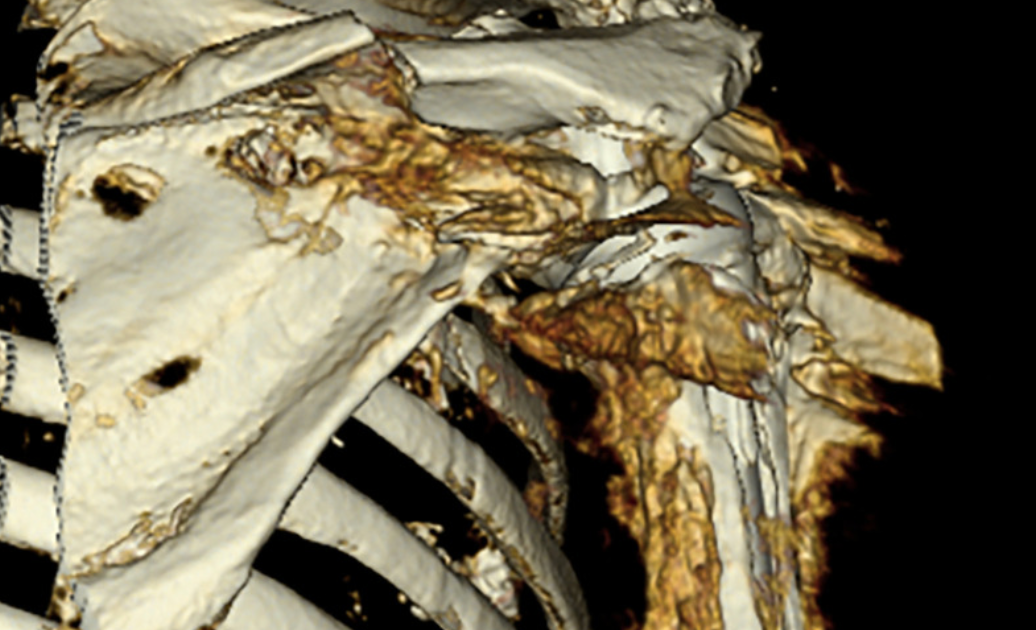
I’ll start out with a few conclusions:
(1) Acromial and scapular spine stress fractures are clinically important complications of reverse total shoulder arthroplasty (RSA), occuring in 3-11% of cases and often resulting in poor functional outcomes such as persistent pain and limited active motion.
(2) The principal risk factors – female sex, advanced age, poor bone quality, inflammatory arthropathy, cuff deficiency, corticosteroid use, thinned acromion from prior surgery or erosion, proximal humeral migration – are not under the control of the surgeon, except as they affect the decision to proceed with RSA surgery.
(3) Surgeons do control humeral and glenosphere component selection and positioning. However the evidence guiding practice is not robust due to the lack of standardized nomenclature and what parameters should be measured in future clinical research.
Here are a set of four easy to make measurements the importance of which is supported by the review below. These address the problem of uncertainty and inconsistency found in published studies regarding RSA geometry. Such measurements will be important in answering the key questions surgeons have: what component positions provide the best function and which minimize the risk of complications such as scapular stress fractures for my patients?
(1) Acromio-humeral distance measured from the acromion to the greater tuberosity along a line parallel to the bony glenoid face (both post-op and pre-op to post-op change).

(2) The perpedicular distance between the glenosphere center of rotation (COR yellow dot) and the glenoid bony face (yellow line)
(3) The perpendicular distance between the lateral extent of the glenosphere and the glenoid bony face (blue line)
(4) The perpendicular distance between the tuberosity and the glenoid bony face (long black line).

Consistent use of these measurements would address much of the current ambiguity in the literature, as illustrated by the following review.
Glenosphere lateralization
One of the issues in reviewing the literature on “glenosphere lateralization” is a failure of many articles to define the term. Are the authors talking about lateralization of the center of rotation in relation to the glenoid bone (yellow line) or lateralization of the lateral aspect of the glenosphere in relation to the glenoid bone (blue line)? The former affects the deltoid moment arm and the range of impingement-free range of motion, while the latter contributes to the global lateralization of the humeral tuberosity (black line) which affects the soft tissue tension that is important for stabilizing the articulation through concavity compression. As seen in Know Your Glenospheres these two dimensions can be varied independently by changing the diameter of curvature of the glenosphere. The effect of the humerus on the global lateralization is the difference between the black and blue lines.

Biomechanical studies
Implant positioning in reverse shoulder arthroplasty has an impact on acromial stresses and The effect of load and plane of elevation on acromial stress after reverse shoulder arthroplasty found that glenosphere lateralization, but not humeral lateralization, increased acromial stress.
Factors Influencing Acromial and Scapular Spine Strain after Reverse Total Shoulder Arthroplasty: A Systematic Review of Biomechanical Studies found glenoid lateralization was consistently associated with increased acromial and scapular spine strain.
In addition, transection of the coracoacromial ligament resulted in significantly increased strains. Although preserving the integrity of the CAL is not an implant-related factor, it is a surgeon-controlled variable. Its importance is demonstrated in two basic science papers: Scapular Ring Preservation: Coracoacromial Ligament Transection Increases Scapular Spine Strains Following Reverse Total Shoulder Arthroplasty and Coracoacromial ligament integrity influences scapular spine strain after reverse shoulder arthroplasty and finally the clinical study Does Preservation of Coracoacromial Ligament Reduce the Acromial Stress Pathology Following Reverse Total Shoulder Arthroplasty? Transection of the coracoacromial ligament consistently increased scapular spine strain in biomechanical studies and was associated with higher clinical fracture rates in the 265-patient study (29.4% vs 13.2% with CAL section vs. preservation).
Clinical evidence
There is a lack of clinical studies that have actually measured the radiographic glenosphere COR lateralization and correlated it with acromial fracture risk.
Humeral position
The humerus can be moved distally by the glenosphere (inferior positioning on the glenoid bone, inferior tilt, inferior offset) and by the humerus (using an onlay component, high positioning of an inlay component). Humerus distalization can be documented in terms of postoperative position or as the change in preoperative to postoperative position.
Different methods have been used to characterize humeral distalization making it difficult to compare studies. It seems most intuitive to directly measure acromiohumeral distance: the distance from the lateral acromion to the lateral prominence of the tuberosity along a line parallel to the glenoid face. This approach can be used both before and after RSA.

The data on the effect of humeral component lateralization on acromial/spine fractures is inconclusive.
Summary: The current data are incomplete and, in many cases, inconclusive. Humeral distalization beyond 20-25mm appears to increase fracture risk (biomechanical threshold ~25mm; clinical data showing 121% increased risk per 10mm increase in delta acromiohumeral distance). Transection of the coracoacromial ligament consistently increased scapular spine strain in biomechanical studies and was associated with higher clinical fracture rates in the 265-patient study (29.4% vs 13.2% acromial pathology with CAL section vs. preservation).
Basic science data suggest that glenosphere COR lateralization may increase fracture risk, but clinical studies using categorical classifications (‘lateralized’ vs ‘non-lateralized’) without actual measurements are inconclusive.
The effect of humeral lateralization remains unclear.
Thus for high-risk patients (elderly women, inflammatory arthropathy, prior acromioplasty, thin acromion), limiting the change in acromiohumeral distance (delta AHD) to <20mm, preserving the CAL, and avoiding excessive glenoid lateralization may be prudent pending better evidence—which will require standardized measurements such as those proposed above.
Fractures

Mt. Rainier National Park
July 2024
Follow on twitter/X: https://x.com/RickMatsen
Follow on facebook: https://www.facebook.com/shoulder.arthritis
Follow on LinkedIn: https://www.linkedin.com/in/rick-matsen-88b1a8133/
Here are some videos that are of shoulder interest
Shoulder arthritis – what you need to know (see this link).
How to x-ray the shoulder (see this link).
The ream and run procedure (see this link)
The total shoulder arthroplasty (see this link)
The cuff tear arthropathy arthroplasty (see this link).
The reverse total shoulder arthroplasty (see this link).
The smooth and move procedure for irreparable rotator cuff tears (see this link)
Shoulder rehabilitation exercises (see this link).

