

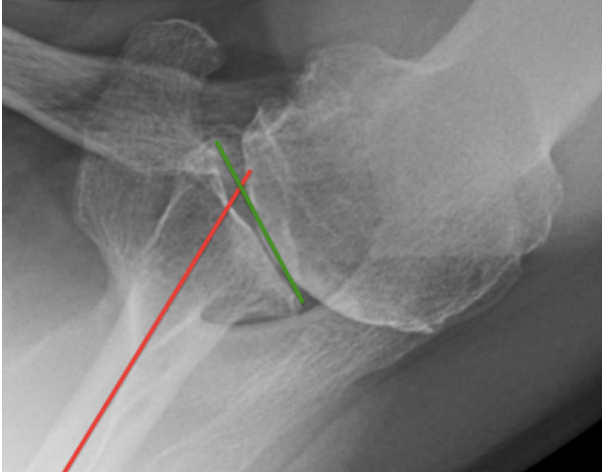
Preoperarive glenoid retroversion is common in shoulders having anatomic total shoulder arthroplasty (aTSA).
Some surgeons contend that – when performing aTSA – it is important to insert the glenoid component in 15 degrees or less retroversion. This is accomplished by eccentric reaming of the anterior glenoid bone, use of a posteriorly augmented glenoid component, or both. As shown below, this approach can come at the cost of removing robust glenoid bone,


And in this set of x-rays obtained 10 years after surgery

The authors of Does postoperative glenoid component retroversion following anatomic total shoulder arthroplasty affect clinical outcomes? A systematic review and meta-analysis reviewed the available evidence relating patient reported outcomes to the retroversion in which an anatomic glenoid component was inserted. Fifteen articles (1,190 shoulders) reporting postoperative clinical outcomes and measurements of glenoid component version after primary anatomic shoulder arthroplasty were identified and submitted for meta-analysis. Patients were divided into 2 groups based on postoperative glenoid component retroversion: (a) < 15° and (b) ≥ 15°. When comparing patient reported outcome scores, range of motion, and complications for shoulders with <15 or ≥15 degrees of glenoid component retroversion, no clinically significant differences were noted between the 2 groups at a mean followup of 51 months. Specifically, the ASES scores, range of motion, complication rates, and revision rates were essentially identical. Shoulders with ≥15 degrees of retroversion had less radiolucency. Corrective (eccentric) reaming was associated with higher complication and revision rates.
Several other recent articles support these findings:
Does glenoid version and its correction affect outcomes in anatomic shoulder arthroplasty? A systematic review “There is currently insufficient evidence that pre- or postoperative glenoid version influences postoperative outcomes independent of other morphologic factors such as joint line medialization. Given that noncorrective reaming demonstrated favorable postoperative outcomes, and postoperative glenoid version was not significantly and consistently found to impact outcomes, there is inconclusive evidence that correcting glenoid retroversion is routinely required.”
Comment:
Substantial resources are being directed at measuring, planning for, and correcting preoperative glenoid retroversion when performing anatomic total shoulder arthroplasty. These recent studies question whether these efforts are of value to the patient when treating arthritic retroversion with aTSA.
What is the best orientation?

Red-tailed hawks in combat
Union Bay Natural Area
Oct 2021

