

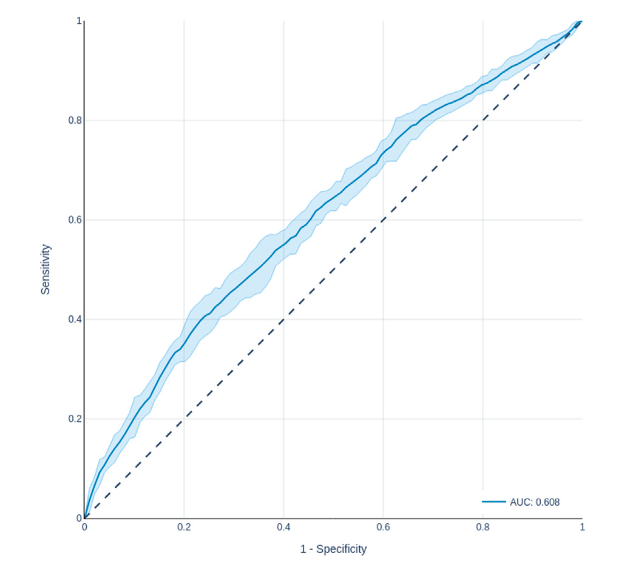
Patient factors (younger age, tobacco use, prior surgery, diagnosis of instability sequelae or nonunion) were stronger predictors of complications than implant design (inlay humeral component, medialized glenoid, medialized humerus, minimal global lateralization, lateralized glenoid-medialized humerus).
The machine learning model achieved an AUC-ROC of 0.61 (the value for random change would be 0.5).
This study reinforces that patient selection and optimization are paramount, with surgical technique and implant design playing less important roles. The findings appear to favor lateralized constructs (glenoid and humeral components) and onlay designs. However, the modest predictive accuracy suggests complications are multifactorial and not easily predicted.
The authors carefully describe the limitations of the study:
(1) the study retrospectively analyzed patients from an
institutional registry
(2) glenoid,
humeral, and global lateralization were measured on digitized templates as opposed to radiographic measures (thus, surgeon technique may have had a major impact on the final implant
position different than the manufacturer specifications).
(3) the case volume of the individual surgeons was not analyzed with respect to complication rate.
(4) the medialized designs were the only
implants available during the learning period of rTSA at this institution; thus it is unclear whether the increased complications associated with this design were related to the design itself or due to surgeon inexperience. In this registry, lateralized constructs were associated with fewer complications, but this may reflect their use in later years by more experienced surgeons in better-selected patients.
(5) the implants with lower
proportions in the study led to more statistical fragility
regarding design parameters
(6) it is not clear whether complications with certain designs (for example, the lateralized glenoid-medialized humerus (LGMH) combination) were due to the implant or to differences in the patient populations receiving the different implants
(7) the modest AUC-ROC of 0.61 suggests that the model did not include additional important predictive factors (e.g. surgical technique, other patient factors).
We might wonder if in the future natural language processing of the entire records of these patients might lead to a model with greater predictive capacity by capturing such potentially important variables as:
- Intraoperative findings (bone quality, soft tissue (subscapularis) condition, unexpected anatomic variants)
- Surgeon operative notes describing technical challenges
- Rehabilitation compliance and early recovery patterns
- Social determinants of health (support systems, living situation)
- Detailed medication histories and comorbidity severity
- Patient expectations and psychological factors
In the end we must ask: Are complications in rTSA fundamentally predictable, or are there elements (e.g., subclinical infections, individual healing variability, unpredictable trauma) that limit any model’s ceiling?
Is the modest AUC of 0.61 due to insufficient data or to irreducible uncertainty (inherent biological variability among patients, intraoperative details, postoperative course)?
See Objective ignorance – a problem in predicting outcomes in climbing and in orthopaedic surgery
Here’s how a conversation with a prospective patient about complications might go.
What we know: “Your age, tobacco use, overall health, nutrition and whether you’ve had prior surgery influence your risk of complications. We can’t change some of these, but we can optimize your nutrition and help with smoking cessation if relevant. At your surgery, we’ll use proven techniques and appropriate implants based on the best available evidence.”
What we don’t know: “Even with sophisticated analysis of thousands of cases, we can only weakly predict who will experience a complication. Much depends on factors we cannot measure or control—how your body responds to surgery, healing variability, and events after you leave the hospital.”
What this means for you: “We focus our efforts where evidence shows they matter most: optimizing your health before surgery, using proven surgical approaches, and supporting your recovery afterward. We avoid expensive technologies that claim precision but haven’t been shown to improve outcomes that matter to patients.”
Shoulder arthritis – what you need to know (see this link).
How to x-ray the shoulder (see this link).
The ream and run procedure (see this link)
The total shoulder arthroplasty (see this link)
The cuff tear arthropathy arthroplasty (see this link).
The reverse total shoulder arthroplasty (see this link).
The smooth and move procedure for irreparable rotator cuff tears (see this link)

