

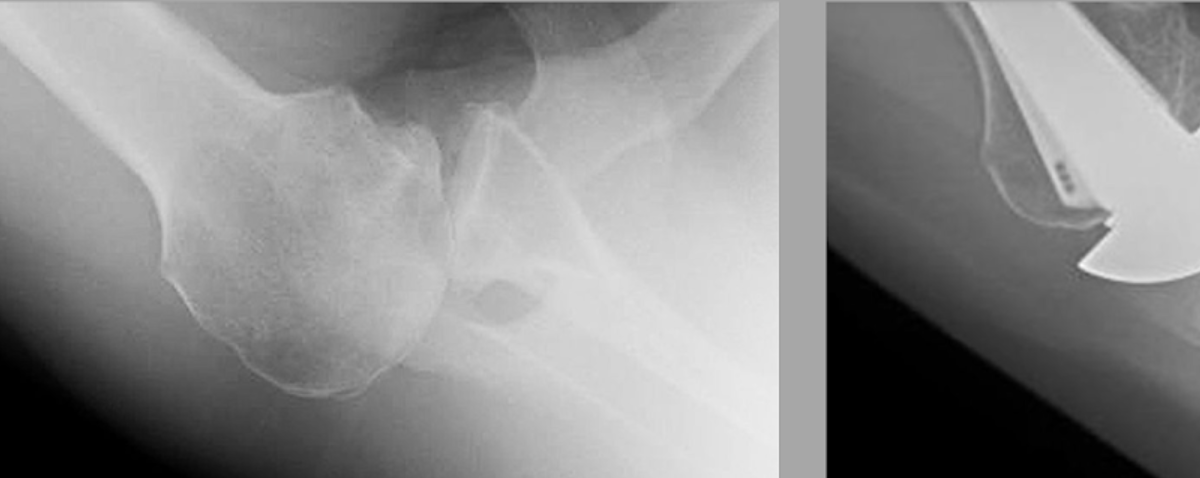
The ream and run (RnR) is a glenohumeral arthroplasty in which the arthritic humeral head is replaced with a chrome-cobalt humeral head similar to that used in conventional total shoulder arthroplasty. The key difference is that rather than implanting a plastic glenoid component, the glenoid bone is conservatively reamed to a concentric concavity and allowed to remodel during the rehabilitation period. This procedure eliminates the limitations and risks of loosening associated with a plastic glenoid component.
Four recent papers contribute to our understanding of the Ream and Run. Note that none of the authors have a financial conflict of interest with the companies making the implants used in these studies.
Brad Carofino, former University of Washington Shoulder Fellow, working in Virginia Beach has provided the most rigorous data on the ream and run to come from a center outside Seattle. Here are two of his recent publications
Paper #1 Comparison of short- and midterm outcomes inpatients following ream-and-run and anatomic total shoulder arthroplasties J. Shoulder Elbow Surg (2025) 34, 794-802. A matched cohort study compared ream and run (RnR) outcomes to anatomic total shoulder arthroplasty (aTSA). The RnR procedures were all performed by an individual surgeon. A multicenter database was used to provide the
matched cohort of patients who underwent the aTSA procedure. Only male patients were included; average age was 56 years.
Of note this surgeon accepts 2 – 8 mm of diametral mismatch between the humeral head and the reamed glenoid when performing the RnR, selecting the reamer size that removes the least amount of bone without attempting to change preoperative glenoid version. When selecting the humeral head implant size, he selected a head diameter to approximate the patient’s anatomy; 54- and 56- mm-diameter heads were the most used sizes. For head height, the surgeon favored the thinnest option for that diameter (15 or 18 mm). Because patients are encouraged to obtain 160 degrees of passive forward elevation within the first few days, range of motion exercises are started the day of surgery and performed 3-5 times per day for the first 6 weeks. Of great importance, this surgical team sees their patients at 2wk, 6wk, 3mth, 6mth, 2,3,5,7,10yr. as standard follow up. They make themselves VERY available and
encourage contact with any and all questions. Close patient followup is critical to a good outcome.
The Simple Shoulder Test and ASES scores for RnR were not inferior to those for aTSA at a mean three-year follow-up; revision rates and satisfaction were essentially the same.


Preoperative humeral decentering was corrected (50% indicates that the humeral head is centered on the glenoid).

Patients self-selecting the RnR arthroplasty reported pain and functional improvements as well as satisfaction ratings similar to those who were not specifically seeking out the procedure. Both groups achieved approximately 84–88% of maximum possible improvement on the SST and approximately 78% on the ASES. More than 93% of patients in both groups reached the minimal clinically important difference.
Two papers came from the University of Washington Shoulder Team.

Medialization occurred predominantly in the first two years as the reamed glenoid adapted to load and tended to level off thereafter. The characteristic amount of medialization at 10 years was 3.5 mm.

Of importance is the observation that medialization did not correlate with outcome: patients with greater medialization achieved SST and ASES scores equivalent to those with less wear. Overall satisfaction exceeded 97%. Twelve shoulders were revised for stiffness or malposition, eight of these were revised to a repeat RnR, one to aTSA, one to RSA, one to CTA hemiarthroplasty, and one was a soft tissue release.
Conclusion: These studies and the preceding literature suggest that RnR with a chrome-cobalt humeral head and conservative reaming without version correction delivers consistent, durable results across follow-up durations, across glenoid morphologies, across surgeons, and across patient selection pathways.
For younger, active patients with cuff-intact glenohumeral arthritis who wish to avoid the risk of glenoid component loosening, the ream and run merits consideration as a first-line operative treatment.
These studies provide data to which alternative approaches, such as pyrocarbon and ceramic heads can be compared.
Here’s an example of the outcome that can be obtained in a well-motivated and physically active patient. The patient kindly gave us permission to show videos of his motion.
Preoperative x-ray on the left, 18 year followup x-ray on the right

Preoperative x-ray on the left, 15 year followup x-ray on the right

Under development

Barred owl chick
Washington Park Arboretum 2024
Follow on twitter/X: https://x.com/RickMatsen
Follow on facebook: https://www.facebook.com/shoulder.arthritis
Follow on LinkedIn: https://www.linkedin.com/in/rickmatsenmd

