

Summary: Three takeaway points
(1) The commonly used and easy to measure “revision rate” is an inadequate endpoint for evaluating rTSA outcomes. The 8–20 percentage point gap that exists between the complication rate and the revision rate includes a substantial number of patients with failed but unrevised reverse shoulder arthroplasties. These patients are not considered in determining the failure rate when measured by the percentage having revision. Complication-free survival or patient-reported outcome measures should supplement or replace revision rate or “implant survival” as the primary outcome measure for rTSA.
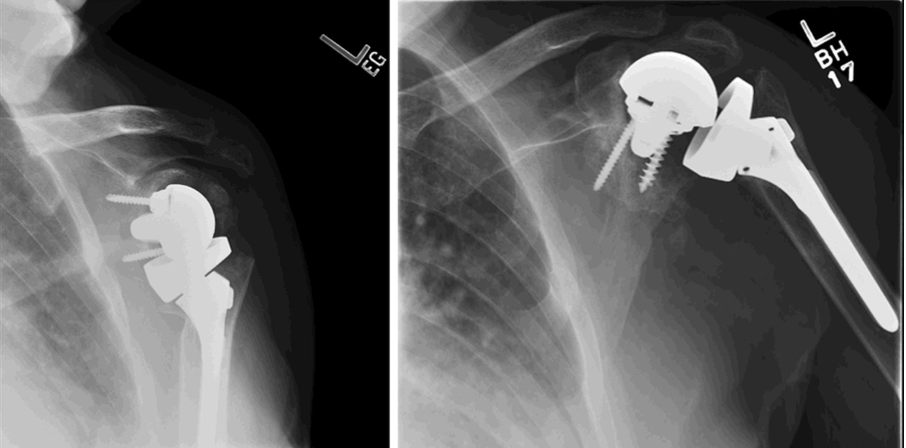
(2) The most common complications of rTSA, acromial and scapular spine fractures, are unique and difficult to solve problems for patients having reverse arthroplasty. In contrast, the most common complications from aTSA – glenoid component loosening and rotator cuff tear – can be effectively managed by revision to a rTSA
(3) The salvage pathway for patients with rTSA failure is poor. Revision rTSA carries a 31% complication rate and 27% re-revision rate, with outcomes that are significantly worse than those for primary rTSA. This contrasts sharply with aTSA-to-rTSA conversion, the outcome of which approaches the outcomes for primary rTSA.
Complications vs revisions
Meta-analytic evidence reports that anatomic total shoulder (aTSA) has a higher rate of revision compared to reverse total shoulder (rTSA). This observation may have driven much of the shift toward rTSA for patients with cuff-intact arthritis. However, it may neglect the fact that surgeons and patients can decide against revision of a failed rTSA because of the low rate of success. Thus, the absence of a revision does not indicate a good outcome.
Outcomes After Revision
The Salvage Pathway Asymmetry: revision for aTSA Failure compared to revision for rTSA Failure
Summary: Three takeaway points (again)
(1) The commonly used and easy to measure “revision rate” is an inadequate endpoint for evaluating rTSA outcomes. The 8–20 percentage point gap that exists between the complication rate and the revision rate includes a substantial number of patients with failed but unrevised reverse shoulder arthroplasties. These patients are not considered in determining the failure rate when measured by the percentage having revision. Complication-free survival or patient-reported outcome measures should supplement or replace revision rate or “implant survival” as the primary outcome measure for rTSA.
(2) The most common complications of rTSA, acromial and scapular spine fractures, are unique and difficult to solve problems for patients having reverse arthroplasty. In contrast, the most common complications from aTSA – glenoid component loosening and rotator cuff tear – can be effectively managed by revision to a rTSA
(3) The salvage pathway for patients with rTSA failure is poor. Revision rTSA carries a 31% complication rate and 27% re-revision rate, with outcomes that are significantly worse than those for primary rTSA. This contrasts sharply with aTSA-to-rTSA conversion, the outcome of which approaches the outcomes for primary rTSA.
Swans reversing course

Trumpeter Swans
Union Bay Natural Area
Seattle

