

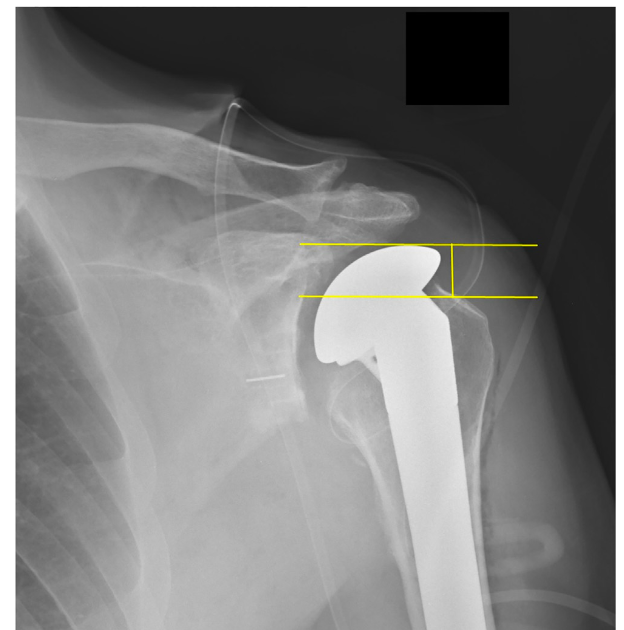
This article is very thought provoking: it merits two posts. Here’s the first.
Knowing full well that the great majority of this blog’s readers would do things differently here’s how we might try to avoid these malpositions in my practice.
A. Humeral head too high

The “head high” problem may be avoided by assuring that the humeral head is placed just below the berm.

Note also in both of these cases the diaphysis of the humeral component was too large, causing stem incarceration, preventing full seating of the component. Stem incarceration may be prevented by using a smaller diameter humeral component with impaction grafting,


using a short stem, or using a stemless component.

B. Insufficient humeral resection

The “long neck” problem may be avoided by full exposure of the anatomic neck for the cut.


The “Baseplate High” problem may be avoided by making preoperative measurements on a plain preoperative Grashey view. Below left, a line segment equal to half the baseplate diameter is drawn from the inferior glenoid to the articular surface perpendicular to the supraspinatus fossa line. A second line segment is drawn from the inferior glenoid lip to the intersection of the first line segment with the articular surface. This distance can me measured at surgery. This intersection indicates the starting point for the drill.

D. Superior tilt of baseplate.

The “baseplate looking up” problem may be avoided by making preoperative measurements on a plain preoperative Grashey view. Below left a line (yellow) is drawn from the drill insertion point (see “C” above) parallel to the supraspinatus fossa line. This is the drill trajectory. Below right the angle between the drill trajectory and the superior face of the glenoid is noted and used to define the tilt of the drill for insertion of the baseplate.


Looking forward to your comments!

Northern Flicker
Matsen Backyard
2022
Shoulder arthritis – what you need to know (see this link).
How to x-ray the shoulder (see this link).
The ream and run procedure (see this link)
The total shoulder arthroplasty (see this link)
The cuff tear arthropathy arthroplasty (see this link).
The reverse total shoulder arthroplasty (see this link).
The smooth and move procedure for irreparable rotator cuff tears (see this link)

