

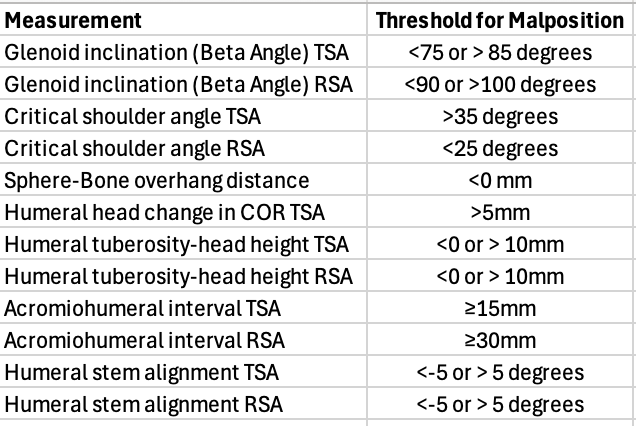
Here are some details: component position was measured on pre-revision
radiographs. “Thresholds for Malposition” were based on values
found in prior publications.
From the above and the figure below it can be seen that the definition of acceptable component position is quite narrow.

The authors note that using narrower thresholds dramatically increases “malposition” rates. For example, lowering the threshold for the change in humeral center of rotation from >5mm to >3mm increased the rate of “malpositioned” components from 45% to 58% of TSA cases. It seems likely that there are many unrevised shoulder arthroplasties with a change in humeral center of rotation exceeding the 5mm or the 3mm thresholds.
This is akin to having the distance between field goal uprights being 3 feet (below right) rather than the regulation 18.5 feet (below left). Narrowing the goal posts does not change the quality of the kicker.

To understand the nature of thresholds, we need scatter plots including both revised and unrevised shoulders that show the relationship between component position and outcomes across the full spectrum of both variables. Such plots would reveal the true clinical significance of positioning variations. These data are not included in this study.
The value of scatter plots is shown by four hypothetical examples illustrating different possible relationships between component positioning and outcomes. Each represents a fundamentally different clinical reality with different implications for the value of precision positioning technology.
Figure 1. Scenario A: Hard Threshold Pattern

This pattern shows a clear inflection point at 5 mm deviation. Below this threshold, outcomes remain excellent with minimal variation. Above it, outcomes deteriorate sharply. The blue dots represent cases without revision, while red dots indicate cases that required revision surgery.
Figure 2. Scenario B: Soft Threshold Pattern (Gradual Decline)

This pattern demonstrates a linear relationship where each degree of deviation causes proportional outcome deterioration. There is no sharp inflection point. Note the increasing concentration of revisions (red dots) as deviation increases, but many poorly-positioned components still function adequately.
Figure 3. Scenario C: No Clear Relationship (Zone of Indifference)

This pattern shows outcomes scattered across the full range regardless of positioning. The flat trend line suggests that within the measured range, this particular positioning parameter has minimal impact on outcomes. Other factors (soft tissue management, patient selection, surgical technique) dominate. The random distribution of revisions (red dots) across all positioning values supports this interpretation.
Figure 4. Scenario D: Inverted U-Shaped Relationship (Optimal Zone)

This pattern demonstrates that extremes in either direction cause poor outcomes, with an optimal zone in the middle. This could represent parameters like humeral version where both excessive anteversion and retroversion are problematic. The concentration of revisions (red dots) at both extremes supports the concept of an optimal middle zone.
Scatter plots such as these reveal (1) the percentage of “well-positioned” implants failed and (2) the percentage of “malpositioned” implants that function successfully and (3) whether it is likely that deviations caused failure, or whether failures have occurred for other reasons, such as instability from poor soft tissue balancing, poor bone quality, infection, or periprosthetic fracture.
Conclusion
The modes of shoulder arthroplasty failure and revision are well established.
Why do primary anatomic total shoulder arthroplasties fail today? A systematic review and meta-analysis identified implant loosening (26.1%), particularly of the glenoid component, as the most common cause of contemporary aTSA failure, followed by rotator cuff insufficiency (17.3%), instability (10.4%), and infection (10.2%)
Notice that the leading causes of failure — loosening, instability, infection — are not primarily positioning problems. Precision technology addresses none of them.
The critical unanswered question is the dose-response relationship between positioning deviation and clinical outcome – four possible patterns are shown by the hypothetical examples above.
Each surgeon needs to ask, “are the complications experienced by my patients likely to be addressed by component positioning between tight goal posts or are they more likely to be addressed by better patient selection, better component seating, better soft tissue balancing, better prophylaxis against infection, or different component selection?”.
Keeping Cool

Dark Eyed Junco
Matsen Backyard
2020
Shoulder arthritis – what you need to know (see this link).
How to x-ray the shoulder (see this link).
The ream and run procedure (see this link)
The total shoulder arthroplasty (see this link)
The cuff tear arthropathy arthroplasty (see this link).
The reverse total shoulder arthroplasty (see this link).
The smooth and move procedure for irreparable rotator cuff tears (see this link)

